Posture and movement analysis are essential for injury prevention, physical rehabilitation, ergonomic assessments, and athletic performance. Traditional evaluation methods are manual, inconsistent, and impractical for continuous monitoring. To solve these limitations, an AI-powered solution was developed that uses computer vision and pose estimation to track human posture, detect movement anomalies, and provide real-time corrective feedback using standard cameras.
Key Takeaways
AI-powered posture tracking uses computer vision and pose estimation to analyze human skeletal movements, detect posture deviations, and provide real-time corrective feedback using standard cameras. This technology enables real-time alerts for posture correction and injury prevention, accessible monitoring with existing hardware, objective and repeatable biomechanical analysis, continuous tracking in homes, gyms, clinics, and workplaces, and data-driven therapy with visual progress reports adaptable across healthcare, fitness, and workplace ergonomics.
Problem Statement
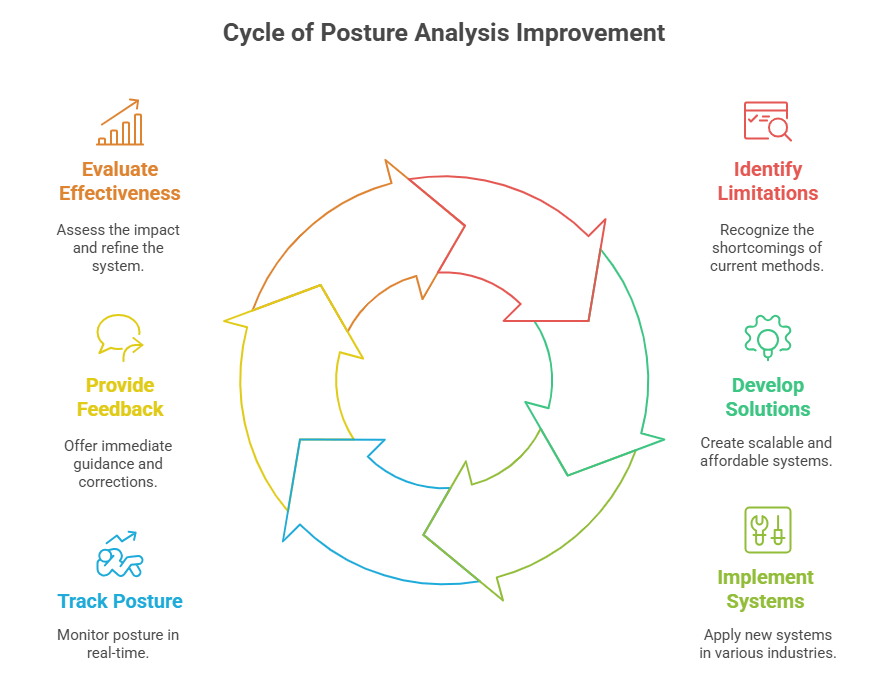
Conventional posture analysis methods rely on expert observation or lab-based motion capture systems, which are expensive, time-consuming, and subjective. Subtle deviations in posture often go unnoticed, leading to injury risks and inconsistent feedback. There’s a lack of real-time guidance during activity, making it difficult to correct form immediately or track recovery progress in clinical scenarios.
Industries such as physiotherapy, sports, and workplace safety needed a scalable, affordable, and intelligent system for continuous posture tracking without specialized hardware.
Solution

A robust AI-based posture tracking system was developed using standard cameras (webcams, smartphones, etc.) to automatically detect and monitor human skeletal movements in real time. The system identifies key joints and evaluates posture using pose estimation algorithms trained on large datasets.
Key Functionalities
Real-Time Skeleton Pose Estimation
- Detects body keypoints (head, shoulders, spine, hips, knees, etc.) and builds a skeletal model of the user.
- Enables posture recognition and deviation tracking on-the-fly.
Intelligent Posture Feedback
- Analyzes spinal curvature, joint angles, and limb symmetry.
- Provides instant feedback such as "straighten your back" or "adjust shoulder position" using on-screen alerts or audio prompts.
Motion Analysis & Repetition Tracking
- Counts exercise reps and rates form quality based on defined movement patterns.
- Supports physical therapy protocols, yoga poses, fitness routines, and workplace lifting techniques.
Historical Insights and Progress Reports
- Tracks user performance over time, helping trainers, doctors, or users monitor trends and recovery progress.
- Generates reports showing improvement in posture alignment, movement accuracy, and ergonomic compliance.
Benefits
- Real-Time Feedback: Users receive instant alerts to correct posture, reducing injury risk.
- Accessibility: Works with existing cameras, with no need for special motion capture gear.
- Consistency: Objective and repeatable analysis compared to human evaluation.
- Continuous Monitoring: Enables daily tracking in homes, gyms, clinics, and workplaces.
- Data-Driven Therapy: Visual reports support better decision-making in training and rehab.
- Scalable & Cross-Domain: Easily adaptable across industries and user types.
Conclusion
AI-powered posture tracking is transforming how we assess human movement. By using intelligent camera-based analysis, this technology brings biomechanical insights into everyday settings, from hospital rooms and home gyms to offices and athletic fields. The system is scalable, cost-effective, and integrates into a wide range of environments, making posture analysis more accurate, accessible, and proactive than ever before.
Similar Use Cases / Applications

- Healthcare & Rehabilitation: Patient recovery tracking, remote physiotherapy, fall prevention.
- Sports & Fitness: Movement coaching, exercise form correction, athlete performance optimization.
- Workplace Ergonomics: Detect unsafe lifting techniques, monitor desk posture, support wellness initiatives.
- Education & Dance: Feedback for online physical education, dance technique improvement.
- Smart Wearables: Embedded in smart mirrors, AR/VR fitness, or posture-correcting clothing.
- Insurance & Legal: Document movement-related recovery for claim evidence.